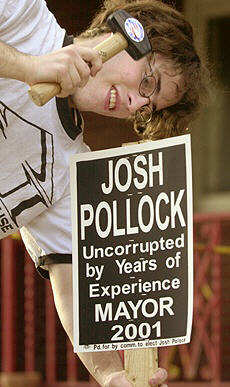
"Josh Pollock: uncorrupted by years of experience"






|
|
| Teen candidate for Pittsburgh mayor has a playfully serious
agenda
Josh isn't joking Thursday, April 26, 2001 By Bob Batz Jr., Post-Gazette Staff Writer Josh Pollock is a punk. He might protest if you called him that meaning
"young, inexperienced person," which is how he was described by one
citizen who vociferously challenged his right to run for Pittsburgh mayor
at the age of 18.
Pollock did fight that legal challenge, and it was withdrawn in late
March. Now "the 18-year-old Squirrel Hill high school student," as the
media tag him, remains one of five men vying for the Democratic nomination
in the May 15 primary.
"Minor candidate" is something he's been called, not because of his
youth, but because he's so far behind the front-runners, incumbent Tom
Murphy and City Council President Bob O'Connor (who both happen to be 56).
The latest Pennsylvania Poll had those two essentially tied at 42
percent and 41 percent, respectively, of voter support. Pollock had 1
percent, which tied him with Leroy L. Hodge, ahead of Earl V. Jones.
Being the extraordinarily young candidate is something that has worked
to Pollock's advantage -- he's probably garnered more publicity than
Hodge, Jones and Republicans Mark Rauterkus and James Carmine combined --
although he knows it also works against him with people who would dismiss
a teen-ager with the p-word.
But he's proud to be what his peers call "punk" -- that is, activist
and non-conformist -- in his politics and other passions, such as music.
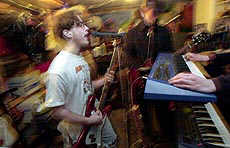
In the first week of January, after all, the bass player/guitarist did
officially announce his run by jamming with his punk metal band Five8Five.
From the beginning, Pittsburgh didn't know whether to take him
seriously. But he and those close to him insist he's been serious all
along -- as serious as he is about abolishing discrimination and embracing
diversity and about other social justice issues that are main parts of his
platform.
He just has a sense of humor, too.
You need to know both sides to begin to understand what kind of person
Joshua Pollock is.
The first news release from this "hardest rocking mayoral candidate" --
it broke Jan. 2 in the Post-Gazette -- noted his involvement with the
Western Pennsylvania Committee to Free Mumia Abu-Jamal. Others very much
want to execute the death-row prisoner, who became a cause celebre
following his conviction in the 1981 murder of a Philadelphia police
officer.
Serious stuff. Yet Pollock's release was written tongue in adolescent
cheek, identifying the senior at the Pittsburgh High School for the
Creative and Performing Arts as "a character with whom the youth of
tomorrow can identify with and he will provide them with hope and strong
leadership or at least some nachos."
When television news crews descended on his school that day, all the
"mainstream media" attention surprised even Pollock (who prepped for
interviews in his American Democracy class).
He later said he and his campaign manager, CAPA junior Michael Garber,
figured they had to be outrageous to get noticed at all.
They've since toned down their well-put-together Web site, http://www.joshformayor.com/,
which outlines Pollock's agenda. Things he'd work for include a living
wage, developing small "uniquely Pittsburgh" businesses and reusing
abandoned buildings and brownfields. Things he'd work against include
racial profiling, police brutality and discrimination against gays.
Serious stuff.
Still, online and in person, he and Garber are ever quick with a quip.
Court challenge
Consider the court challenge last month, which could have killed their
campaign: Bernice Scott of Stanton Heights asked a judge to remove Pollock
from the ballot, contending that his candidacy flouts a state law
requiring the mayor of a city of Pittsburgh's size to be at least 25.
Pollock held that the law is superseded by the city's home rule charter,
which doesn't specify age; his attorney further argued that morning that
even if the age requirement did apply, it was too early in the election
process to object.
Pollock, looking uncomfortable, not to mention unusual, in a jacket and
tie, arrived late, saying, "My next issue is Downtown parking. ... This is
ridiculous." He had a case of his infectious giggles. "Today, when I hand
over that parking money, it's, 'Oh, there goes that Smashing Pumpkins CD I
wanted so badly.' "
After his hearing was postponed (for good, it turned out), the media
throng surrounded Scott, a grandmotherly woman who launched into a
young-punk rant about how Pollock has no "experience in the political
system" and "his attitude is too youthful" and so on.
Garber waited a beat, then held up a campaign button and deadpanned,
"Anyone want one of our buttons that says 'Uncorrupted by Years of
Experience' "?
Pollock giggled some more.
Nonetheless, when the cameras and notebooks were aimed at him, along
with the skeptical questions such as "How can you expect to win?" Pollock
was polished in saying he could win if people vote for him, and he wanted
to continue to run for the same reason he'd started: To provide a new
voice on different issues.
That's what he'll keep doing through May 15, and maybe beyond.
A close family
Pollock decided to run last fall after volunteering for presidential
candidate Ralph Nader and the Green Party. Like them, he wanted to offer
an alternative.
He certainly is that.
On a recent evening, his parents, Rita and David, are sitting in the
living room talking to a reporter about their younger son when he comes
down the stairs in his trademark wrinkled T-shirt, doodled-upon jeans and
road-killed athletic shoes -- an ensemble that would be rejected by most
thrift stores.
"You're looking very mayoral," says his dad.
"I'm looking my mayoralest!" replies a grinning Josh, who favors a
green Army jacket with a red "Stop Executions" button.
This is Josh. And this is how he appeared to the public in his
campaign's early days, when his only concession was to cut his hair, if
not necessarily brush it. He's generally been dressing better for his
increasingly frequent appearances with the other candidates. But he's
often in the same teal or blue dress shirts and same tie and the same
brown dress shoes, which he borrows from his dad.
On this night, Josh is only having dinner with other teens at the home
of his rabbi. Then, he promises, he's coming back to campaign headquarters
-- that is, home -- to stuff the fund-raising letters piled on the dining
room table.
This is the kind of close, busy, involved-in-the-community household
that would support a member running for whatever, say his parents. Josh
started reading on his own with a newspaper, and has long been interested
in current events and issues. Still they weren't sure if he was just
joking about faxing out his mayoral press releases, says his mom, now
special projects manager for the Southwestern Pennsylvania Commission.
An even younger Josh had fully crafted plans before he approached her
about joining a swim team and become a soccer referee.
She and her husband, a Downtown family law attorney, proudly tell how
good Josh was as a counselor last year at Emma Kaufmann Camp, where he was
a longtime camper. He's also worked summers at city farm markets. He's an
A and B student. Voracious reader. Atroshus speller.
Josh would laugh at that. His humor has held things together in
stressful family situations, such as his older brother, Adam, who now
works in Silicon Valley, learning to drive.
Dad, who serves as the campaign's treasurer, says he knew Josh was
serious when he heard him on Jan. 2 doing radio interviews at 5:30 a.m.
"Josh is never up," he says with a laugh. "Oh, yes he is, if he
hasn't been to bed."
Always busy
Even before this campaign, the energetic Josh always was running -- to
activities such as Amnesty International and B'nai B'rith Youth
Organization, as well as to his various demonstrations and music shows and
gigs. In addition to playing at them, he promotes shows, such as Saturday
night's triple bill at the Millvale Industrial Theater with what's now his
main band, the more pop than punk Joybox. For a time, he co-ran a record
label with a now really ex-girlfriend (don't ask, he won't tell).
He's even got a solo CD that he means to finish. So, it's not unusual for
him to be dining after 11 p.m. at the Murray Avenue Eat 'N Park or perhaps
his favorite haunt, the Original Hot Dog Shop in Oakland.
He's a vegan -- he's hasn't eaten meat since visiting with a youth
group tour the Nazi death camp at Auschwitz -- but happily there's no
issue with O fries.
He can and will tell you all the facts about how much more efficient it
is to eat grains, says his omnivorous friend Nick Jarvik. The drummer for
Joybox says most people don't mind Josh talking about his beliefs because
he's smart and he's sincere.
"He's respectful of everyone's view," says Jarvik, who's also 18 and a
senior at Allderdice. He agrees with the Pollocks about their son's
organizational skills and general good-guyness. But Jarvik goes back with
him to the sixth grade at Frick International Studies Academy, when Josh
was more of a goof. Another friend, Matt Freund, says an art teacher there
still remembers the would-be mayor as the kid who painted his whole face
red.
Though he always was trying to make people laugh, Pollock says some of
his antics rose out of excess angst and depression that took the fun out
of middle school.
A teacher changed his life
He transferred to the private University School in Shadyside, where he
met someone who changed his life: English teacher Mary Schinhofen. Through
Native American literature, she introduced him to causes such as that of
prisoner Leonard Peltier, who was convicted -- some say wrongly -- of
killing two FBI agents in 1975.
Josh wrote a paper about Peltier, and so was born a young activist.
"I never even knew that it took root," says Schinhofen, who had Pollock
again in 11th grade before he transferred to CAPA. She says he is an
"interesting student" because as difficult as he is to move on things that
don't interest him, "he throws himself heart and soul into things he
believes in."
If you get to hear him speak, or better, talk with him, it's clear how
serious Pollock is about, say, racial inequity, something he first noticed
when he was attending East Hills Elementary, in the way the roads got
worse on the way from his mostly white neighborhood through mostly black
neighborhoods. "When I figured it out, it was pretty disgusting to me."
He's running for mayor because he wants to not only fix such problems
but also change the attitudes that contribute to them.
Plus, he doesn't like Murphy or O'Connor, whom he dismisses as "career
politicians" dedicated to the status quo. "We need something radically
different," says Pollock, who stresses how he would rethink city
government, but with the help of a team of people with appropriate
experience and expertise.
Now he's working himself to exhaustion -- personally answering the
daily deluge of calls and e-mails, sending press releases, making
appearances. Tuesday, he took off school again -- it's cool, he's a
senior, mostly worried about passing health and gym -- to attend three
candidate forums.
At these, he tries to talk to as many other "normal people" as
possible, since it's his best way to reach them. He doesn't have TV
commercials or billboards, since, partly because of his aversion to large
contributions, his campaign fund is as minuscule as his "staff." Mostly,
that's just Garber, who drives him to many events since the
mass-transit-preferring Pollock, who just got his driver's license in
January, is a menace behind the wheel.
They only half joke about this. Pollock's hand-me-down 1991 Nissan
Maxima isn't as bad as he can make it sound, at least now that the brakes
are fixed. On a recent sweep through the East End to put up a few more of
the 250 small signs the campaign just had printed, he drives pretty well,
albeit with his left foot sometimes propped up on the dash. Jazz blasts
from the cassette deck -- the late Jaco Pastorius, he says. "My favorite
composer and a bass player, no less."
Pollock may have the licks on the bass, but his parallel parking sucks.
As one overly anxious driver whips around him, he cracks, "That guy was
going to vote for me, but now he's voting for O'Connor," and he puts on
his flashers, with the back of the car four feet from the curb.
He has to watch it now that he's a celebrity -- "The mayor kid!" --
especially in Squirrel Hill. Many people tell him that he's got their
vote. More tell them that they support his candidacy on principle -- and
on his personality.
His supporters
Gloria Forouzan, who was until recently the executive director of the
young professional's group PUMP (Pittsburgh Urban Magnet Project), put a
homemade sign supporting Pollock "4" mayor on her Beacon Street porch
before she got one of the neat new printed ones.
His "Uncorrupted" slogan makes her laugh, and she likes that. But she
also agrees with his positions, from civil rights down to his personal
crusade to allow citizens to post fliers. The fact that he's 18 and
running for mayor in such a senior-citizen-filled city, "I think it's
fantastic!" she says, and she's 46.
"I think it inspires young people to do something," she says, pointing
out how in fact her 19-year-old daughter, Leila, now wants to get
involved. "Even if you're a young Republican, the fact is, you see an
18-year-old who's actually doing it." She's surprised Pollock hasn't
attracted national press.
A brief story about him appeared in Education Week, and he's gotten
nibbles of interest from big outlets ranging from CNN to the Today Show.
But he'd be thrilled with more local attention, especially if it would
focus not on his age, but on his plans for making the city a better place
for all people.
"I'm pretty discouraged by the system. At points I just feel like a
stage prop," since the established candidates -- Murphy and O'Connor --
tend to get much more time at events and more coverage in the news.
Just one of many times he's felt slighted was in a Post-Gazette story
about a recent arts community forum at The Andy Warhol Museum. It was bad
enough that he was given just 10 minutes to speak compared to 20 for
Murphy and O'Connor (that frequently happens). He was happy to be invited
and happy to receive an enthusiastic response (that frequently happens,
too).
But when he read the paper the next morning, he got just one light
quote at the end of the story, about how much he'd love to have the band
Rusted Root play at his inauguration.
"That peeved me. I talked about issues that night," including building
more new art spaces and starting new theater and music festivals here.
(The reporter had chosen to focus on the stated promises of the candidates
who are more likely to win.)
He knows the other non-leading candidates get frustrated, too, at how
democracy isn't always all that it's cracked up to be. As he put it in a
song he wrote this fall, "What's the point of democracy if you vote
against your conscience?"
You want serious Josh? This is him: "You should be voting for the
people you believe in and agree with," he says. "Then you've made a
statement."
He's always insisted that he's running to win, to serve the people with
one four-year term, and then go back to being a normal person, probably by
going off to college. He's been accepted to the Musicians Institute of
Technology in Los Angeles and Antioch College in Yellow Springs, Ohio,
though "record producer" seemed to have the career edge over activist.
As the campaign goes into the stretch, he's still plugging away, with
the hard work and the humor ("One of my favorite lines to my friends is,
'By this time next year, when I'm mayor, which is pretty much unavoidable
at this point ...' " )
If, privately, he's more willing to acknowledge the possibility of not
winning the Democratic nomination, perhaps it's because he's beginning to
see all the other ways he can win -- from raising issues to inspiring
others to even opening doors for himself to run for office in the future.
Give up? No way. Remember, Josh Pollock is a punk.
"I'm already bitter and hating politics," he says with one of his
giggles. "That was me at the outset."
|
Meet the Campaign Staff Contact the WebDesigner |