|
The
New People |
||
|
|


Searching for the truth in Jenin
By Kathy Kelly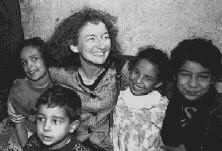
Kathy Kelly and Jeff Guntzel help
coordinate Voices in the Wilderness, a campaign to end the economic sanctions against Iraq.
In that capacity, Kathy spoke in Pittsburgh on February 7. (reported in The New
People March issue) They traveled to Palestine in
response to calls from the International Solidarity Movement and other organizations
working to reduce violence in the region and nonviolently resist Israeli Occupation of
Palestine. Kathy sent this testimony of her time
in Jenin refugee camp.
April 20, 2002
On April 17, we entered the Jenin camp
for a third time, accompanied by Thawra.
We had met Thawra the night we first
entered Jenin. She came into the crowded, makeshift clinic organized by Palestinian Medical
Relief Committee workers, cradling Ziad, an 18-day-old infant born on the first night of the
attack against Jenin. Like most of the young
Palestinian workers volunteering with the Medical
Relief Committee, she wore a hijab and blue jeans.
She had slept very little in the past ten days,
working constantly to assist refugees from the camp.
Her fiance, Mustafa, was missing. Many people whispered to us that they were sure he was
killed inside the Jenin camp, but that Thawra still
hoped he was alive.
Today was Thawra's first chance to find
out what had happened to her home. She and her family lived on the first floor of a three-story
building. Mustafa lived on the third floor.
Entering the camp, we noticed
spray-painted images that Israeli soldiers must have made
the night before. On the entrance gate to one
building, in blue paint, was a stick figure image of
a little girl holding the Israeli flag... Next to it was
a Star of David with an exclamation point inside the star.
We passed Israeli soldiers preparing to
leave the house they had occupied. Five soldiers
and an Armoured Personnel Carrier positioned themselves to protect a soldier as he walked out of
the house carrying the garbage. "Five soldiers
and an APC to take out the trash," said Jeff.
"That's a sure sign that something is radically wrong."
Most of the homes at the edge of the
camp are somewhat intact, although doors, windows and walls are badly damaged by tank shells
and Apache bullets. Each home that we entered was ransacked. Drawers, desks and closets
were emptied. Refrigerators were turned over, light
fixtures pulled out of the walls, clothing torn.
I thought of the stories women told me,
earlier that morning, about
Israeli soldiers entering their homes with
large dogs that sniffed at the children as neighbors
fled from explosions, snipers, fires and the
nightmare chases of bulldozers.
Recovery will take a very long time.
As we climbed higher, entering the
demolished center of the camp where close to 100
housing units have been flattened by Israeli
Defense Forces, we heard snipers shooting at a small
group of men who had come to pull bodies from the rubble. Covered with dust and sweat, and
seemingly oblivious to the gunshots, the men, all
residents from the camp, pursued the grim task. With pickaxes and shovels, they dug a mass grave.
They pulled four bodies out of the rubble, including that of a small child. Little boys stood
still, silently watching.
One of the many soldiers who stopped us
as we walked into Jenin City, several days
earlier, told us there were no children in the camp
during the attack. That was a lie. But now I wonder if
it may have become a strange truth. The concerned frowns on the little boys' faces belonged to
hardened men.
An older boy, perhaps 10 or 11 years
old, helped carry his father's corpse to the mass grave.
Jeff sat down on a rock and shook his head.
"After September 11, I drove toward New York City, and all along the highway carloads of
volunteer firemen sped past me, coming from all
over the country, to help at Ground Zero. Here,
bullets paid for by U.S. taxpayers are being fired
on people simply trying to bury their dead."
A family trudged single file, silently,
uphill through the debris, carrying their belongings
on their heads. Their faces were wracked with
grief. One woman carried an infant in her arms.
No one spoke as they approached the hilltop. At
the top of the hill, in front of a house that was
still somewhat intact, a large family was seated
as though posed for a family photograph,
surrounded by devastation.
Thawra led us to what was once her
home. The house is still standing, but every other
house in the area is completely demolished. She
quickly collected some clothes, then went to the third floor and returned
holding Mustafa's blue jeans in her arms. Her eyes welled with tears. We began
to wonder if she had lost all hope of finding Mustafa.
Outside her home, we met
8-year-old Ahmad. He had found six shiny, small
bullets which he showed to his neighbor, Mohammed Abdul Khalil. Mohammed is a 42-year-old
mason, also trained as an accountant. Having
worked in Brazil and Jordan, he now speaks four
languages. In Spanish, he told me that he built
many kitchens in this area. Mohammed nodded kindly at Ahmad.
A few feet away, Hitan, age 20, and
Noor, age 16, dug through the debris with their
bare hands to retrieve some few belongings. Hitan found a favorite jacket, torn and covered
with dust. She fingered the pockets, then set it aside.
Noor laughed as she unearthed a matching pair of shoes. Then Hitan saw the edge of a
textbook and the sisters began vigorously digging and
tugging until they pulled out five battered and
unusable books. Noor held up her public health
textbook. Hitan clutched The History of Islamic
Civilization.
"You see these girls, they are laughing
and seem playful," said, Mohammed, again
speaking in Spanish. "It is, you know, a coping
mechanism. How else can they manage what they feel?"
Hitan stood and pointed emphatically at the small hole she and Noor had dug. "You know,"
she exclaims, "underneath here, there are four
televisions and two computers! All gone. Finished."
Thawra stared sadly, then persisted with
her search for information about Mustafa.
I asked Mohammed if he knew a man
sorting through a huge mound of rubble next to
where we stood.
"He is my cousin. That was our home.
He wants to find his passport or his children's
documents."
Mohammed's cousin then sat down on top
of the heap that was once his home, holding his
head in his hands.
An army surveillance plane flew overhead.
"We are clear," said Mohammed. "We
are not animals. We are people with hearts and
blood, just like you. I love my son. I want the life for
my family. What force do we have here? Is this a force?" He pointed to the wreckage all
around us. "Do we have the atomic bomb? Do we
have anthrax?"
As we walked away, Jeff pointed at a
bone sticking out of the debris. We stepped
gingerly around it. Thawra dipped down to pick up a
veil lying on the ground, then paused a moment and placed it over the bone.
The New People Table of Contents, May 2002