

ABOUT MY FEDERAL SERVICE FOR MY COUNTRY (return to homepage)
|
ABOUT MY BIOENGINEERING WORK WITH
“Dr. Brack G. Hattler took patients for whom other doctors had given up all hope. In one case, he gave a woman a double lung transplant, then danced the tango with her months later.” Pittsburgh Post Gazette |
||
|
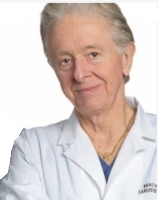
Dr. Hattler earned an undergraduate degree in French from Duke University, then a medical degree from Cornell University. He then earned a PhD in microbiology and immunology from Duke, while serving as Chief Resident in Cardiac Surgery. He was a battlefield surgeon in Vietnam. He returned home to serve as the Chief of US Army Organ Transplant Service at Walter Reed National Military Medical Center. |
|
|
|
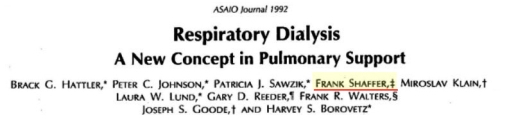
In Vietnam, he watched helplessly while US soldiers were suffocating because their lungs had been damaged by chemical agents of war. That inspired Dr. Hattler to invent a catheter that can be quickly inserted through a vein in the leg and into a patient’s vena cava to add oxygen and remove carbon dioxide from the bloodstream. It is now known as the Hattler Respiratory Support Catheter . Dr Hattler later became Chief of Lung Transplantation at the University of Pittsburgh Presbyterian Hospital. In 1991, Distinguished Professor of Bioengineering Dr. Harvey S. Borovetz introduced me to Dr. Hattler. Here’s our original paper introducing the Hattler Respiratory Support Catheter at the 1992 Annual Meeting of the American Society of Artificial Internal Organs in San Francisco.
J. ASAIO, Volume. 38, Issue Number 3, 1992
Below is a photo of me in my DOE lab applying the flow imaging technology of US Patent 5,333,044 to an in-vitro version of the Hattler Respiratory Support Catheter. Dr. Hattler and his team worked together with me and the DOE staff in my Particle Flow Research Lab at the DOE Pittsburgh Energy Technology Center. Our work was done under a Cooperative Research and Development Agreement (CRADA) already in place with the University of Pittsburgh School of Medicine. It was the first CRADA between the DOE and an outside organization. It was for my work with Distinguished Professor of Bioengineering Dr. Harvey S. Borovetz on an artificial heart, the Novacor Left Ventricular Assist Device (LVAD). |
||
|
|
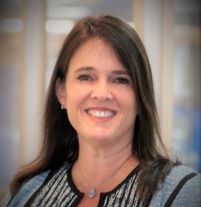
Dr. Laura Lund
|
|
|
Since the COVID epidemic in 2021, the next generation of the Hattler Respiratory Support System, the
|
||

|
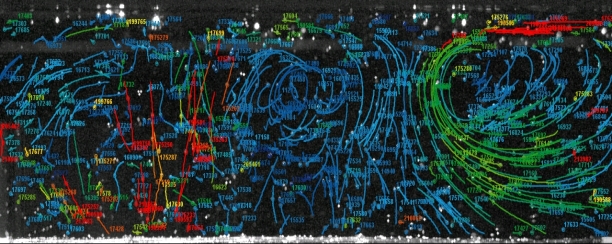
I created the video shown below using the flow imaging technology of my US Patent 5,333,044 to visualize and measure the flow of blood cells driven by the micro-turbine (5mm diameter) in the Hattler Respiratory Support Catheter. The micro-turbine is spinning at 5000 RPM.
Below is a Particle Tracking Velocimetry (PTV) map of the Lagrangian trajectories of tracer particles.
Each trajectory is pseudocolored by the average speed along the trajectory.
|
ABOUT MY FEDERAL SERVICE FOR MY COUNTRY (Return to Homepage)
|
|