ABOUT MY FEDERAL SERVICE FOR MY COUNTRY (return to homepage)
THE VALUE OF MY US PATENT 8,391,552
|
For my report on the millions of taxpayer dollars, decades of engineering time, and nuclear weapons technologies that went into the development of US Patent 8,319,552, follow this link:
|

|
After I was forced to flee federal service in 2018 to protect my life (see this webpage for The Attacks that forced me to flee federal service) , NETL Chief Counsel Susan E. Malie and other federal employees at the USDOE NETL disguised the technology of my US Patent 8,391,552 as a non-patented “open source” technology called “NETL Tracker.” They replaced my name with theirs.
|
|
USING MY U.S. PATENT 8,391,552 TO PRODUCE THE FIRST, ACCURATE, OFFICIAL MEASURE OF THE FLOW RATE OF CRUDE OIL DISCHARGING INTO THE GULF OF MEXICO 5000 FEET DEEP BELOW BP’s EXPLODED DEEPWATER HORIZON OIL RIG To design a capping system to stop the discharge of crude oil into the Gulf of Mexico, an accurate, official, measure of the flow rate was needed. Below is Figure 4 from the peer-reviewed journal paper I co-authored with the Director of the US Geological Survey, Dr. Marcia McNutt. Marcia is now the President of the National Academy of Sciences. We published our paper, Review of the Flow Rate Estimates of the Deepwater Horizon Oil Leak , in the peer-reviewed Proceedings of the National Academy of Sciences (NAS). The NAS was founded by Abraham Lincoln in 1863 to serve as pro bono “Advisors to the Nation” on all scientific matters. The true flow rate ( the light blue band around the dotted-line ) was measured when the leak was capped by using the capping system as a venturi meter. I developed the first accurate official measure of the flow rate ( the green line labeled NETL ), followed by Lemont-Doherty Earth Observatory (LDEO) and Woods Hole Oceanographic Institution (WHOI). I submitted my official estimate seven days before anyone else. This allowed the design of the capping system to begin seven days earlier. The fine under the Clean Water Act was $293 million per day. I could argue that the technology of my US Patent 8,391,552 saved British Petroleum $2 billion in fines. In addition to that, independent experts reviewed the technology of 8,391,552 and found it to be something the petrochemical industry had sought for 50 years … OFFICIAL ESTIMATES OF THE FLOW RATE DURING THE CRISIS
|
|
I had USDOE Patent Attorney James Potts submit the application for my US Patent 8,391,552 on April 22, 2010. This was two days after I learned that huge jets of crude oil were gushing into the Gulf of Mexico a mile deep below the exploded Deepwater Horizon oil rig.
What I learned from the technology of Patent 8,391,552 is that no automatic technology would work for deep sea oil leak jets. So I resorted to manual analysis to produce the first accurate measure of the flow rate. Later, with UC Berkeley and the OHMSETT facility at Naval Weapons Station Earle, we won funding from the USDOI Bureau of Safety and Environmental Enforcement (BSEE) through an open public competitive solicitation to do the research to make Patent 8,391,552 work for measurement of deep sea oil leaks. |
|
The technology of 8,391,552 gave the world the ability, for the first time, to see and measure individual particle motion inside flows of very high particle concentrations. In 2013, the US Patent & Trademark Office protected the technology of 8,391,552. The technology of US Patent 8,391,552 provided the following firsts: First observation and measurement of the flow of blood cells in artificial hearts and lungs, including thrombogenesis (formation of clots) and hemolysis (damage to blood cells). First observation and measurement of the following phenomenon in research scale, pilot scale and industrial petrochemical processing units: o Particle clustering o Random particle motion o Granular Temperature o Particle-Particle collisions o Particle-wall collisions o Particle rotation One of the most valuable applications of U.S. Patent 8,391,552 is in the calibration of Computational Fluid Dynamics (CFD) models like NETL’s MFIX and CPFD’s Barracuda model. This is done by applying 8,391,552 to measure Lagrangian particle trajectories in a small two-dimensional fluidized bed. This was an original, unique idea I invented. Click here to see my original Project Concept disclosing my invention to the NETL Multiphase Flow Group |
|
Seeing is believing . You can see Patent 8,391,552 at work in the video I made: The Science and Beauty of Fluidization . It is dedicated to one of the pioneers in Kinetic Theory of dense particle flows, Distinguished Professor Jennifer Sinclair, UC Irvine. |
|
|
Click here or on the image below to watch Patent 8,391,552 in action
|
|
|
Patent 8,391,552 can be used to improve the performance of any process using high concentrations of particles, bubbles, or droplets, including: pharmaceutical blending; chemical processing; turbine blood pumps; turbine propulsion; propeller cavitation (cavitation produces noise that can be detected hundreds of miles away and casuse propeller damage); artificial hearts and lungs; centrifuge particle separation by size or density; flow visualization; high speed centrifuges for uranium isotope separation, etc. |
|
|
ANNOUNCEMENTS BY THE US DEPARTMENT OF ENERGY
|
|
On January 8, 2010, during an “All Hands Meeting” the Director of the National Energy Technology Laboratory, Rita Bajura, announced the value of 8,391,552 to all 535 federal employees and 1000 contractor employees of the NETL. Here’s the slide from the Director’s presentation:
|
|
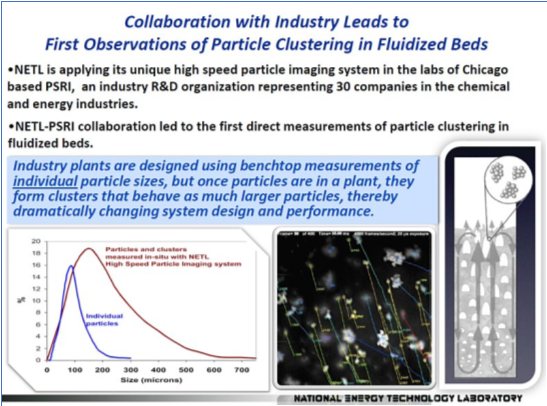
In 2011, the Director of NETL’s Office of Research & Development, Dr. Cynthia Powellannounced the successful application of 8,391,552 to petrochemical units at PSRI in Chicago:
|
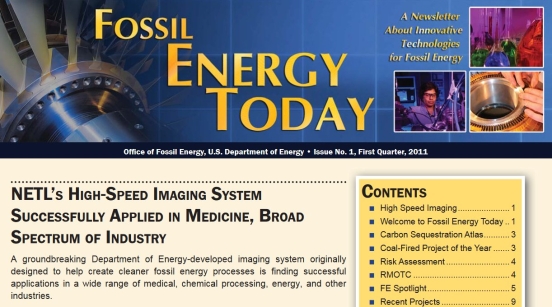
The following announcement has been on the website of the
USDOE Office of Fossil Energy for fifteen years:
Click here or on the graphic below to see the announcement:
|
The following article has been on the
|
|
REVIEWS BY INDEPENDENT EXPERTS FROM OUTSIDE THE DOE OF THE TECHNOLOGY OF MY US PATENT 8,391,552 |
|
|
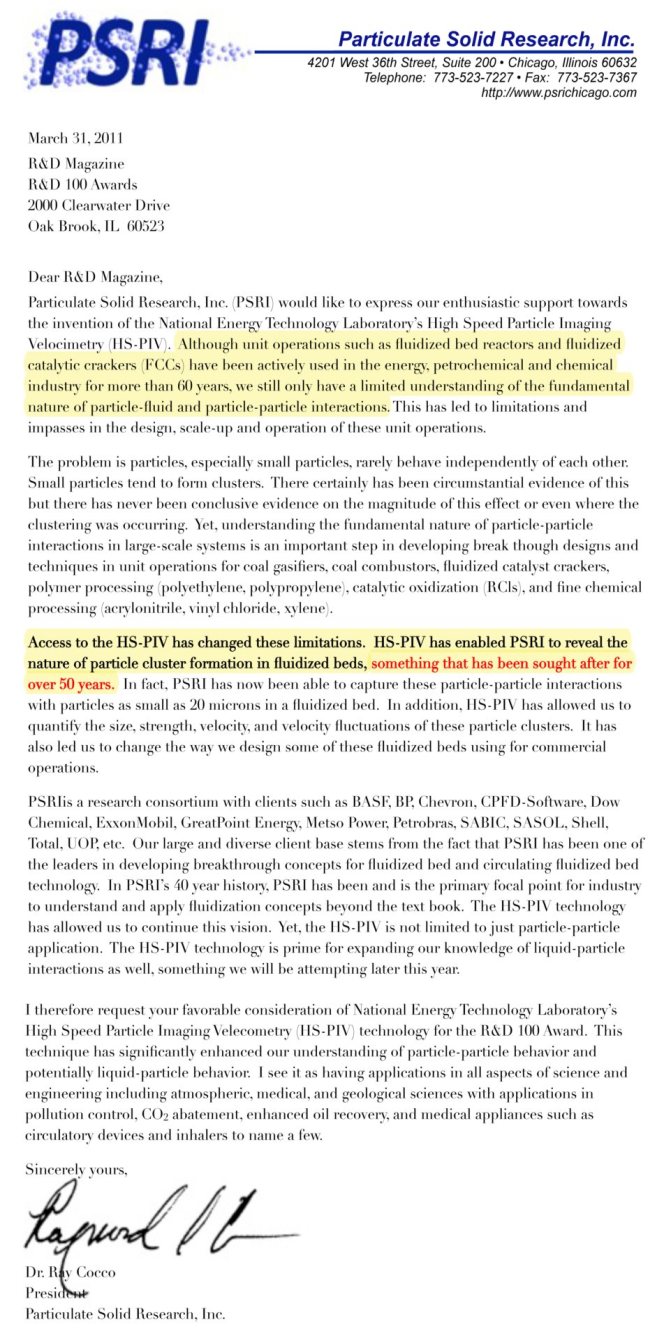
“Particulate Solid Research, Inc. (PSRI) would like to express our enthusiastic support towards the invention of the National Energy Technology Laboratory’s (NETL) HS-PIV technology. Although unit operations such as fluidized bed reactors and fluidized catalytic crackers (FCC’s) have been actively used in the energy, petrochemical and chemical industry for more than 60 years, we still only have a limited understanding of the fundamental nature of particle-fluid and particle-particle interactions. This has led to limitations and impasses in the design, scale-up and operations of these units” Access to HS-PIV has changed these limitations. HS-PIV has enabled PSRI to reveal the nature of particle cluster formation in fluidized beds, something that has been sought after for over 50 years .” The full letter from Dr. Cocco is below in this document. |
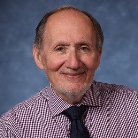
Dr. Ray Cocco,
|
|
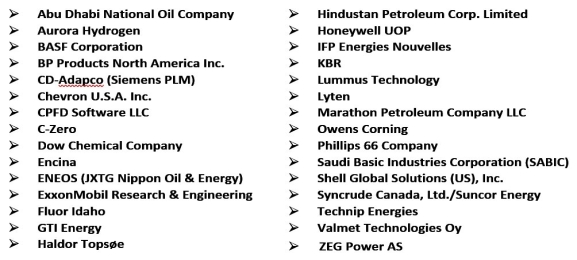
Here is a list of the members of PSRI from the petrochemical industry:
|
|
|
In June of 2017, Patent 8,391,552 was featured an article
|
|
|
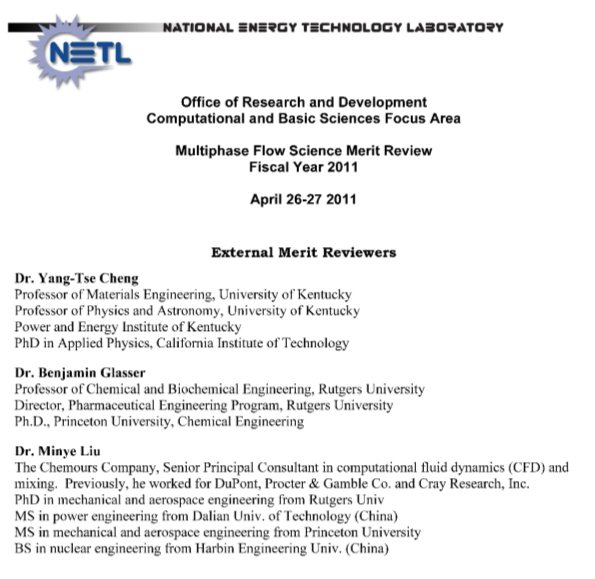
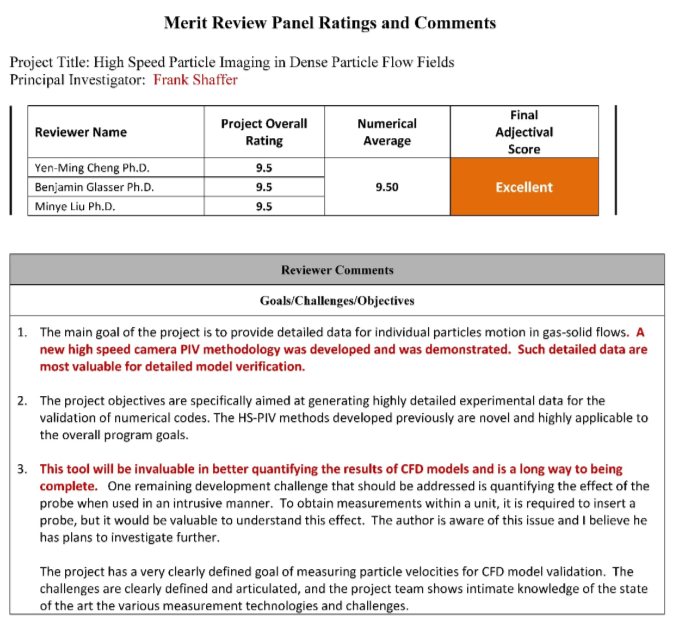
Below are selected comments from Merit Reviews at the NETL by External Experts
in 2009 - 2012.
Their full, unedited, Merit Reviews
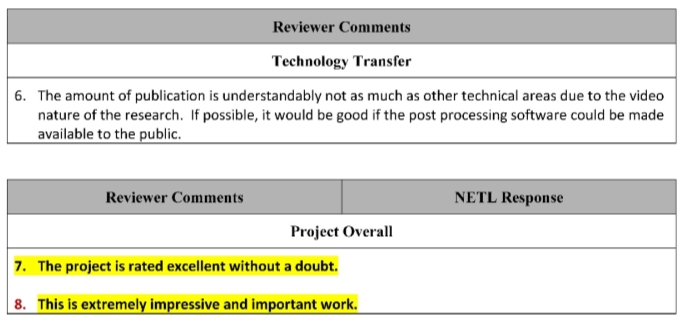
Selected Comments by Independent Experts Project Title: High Speed Particle Imaging in Dense Particle Flow Fields Principal Investigator: Frank Shaffer Overall Rating: Excellent
“The high-speed imaging technique produces very impressive
“The results clearly show the details of the gas-solid flow field
“It is a breakthrough!” “This is impressive and groundbreaking work.”
“The project certainly clearly and directly
“This is extremely impressive and important work.” “The project is rated excellent without a doubt.” |
|
SELECTED COMMENTS BY INDEPENDENT EXPERTS
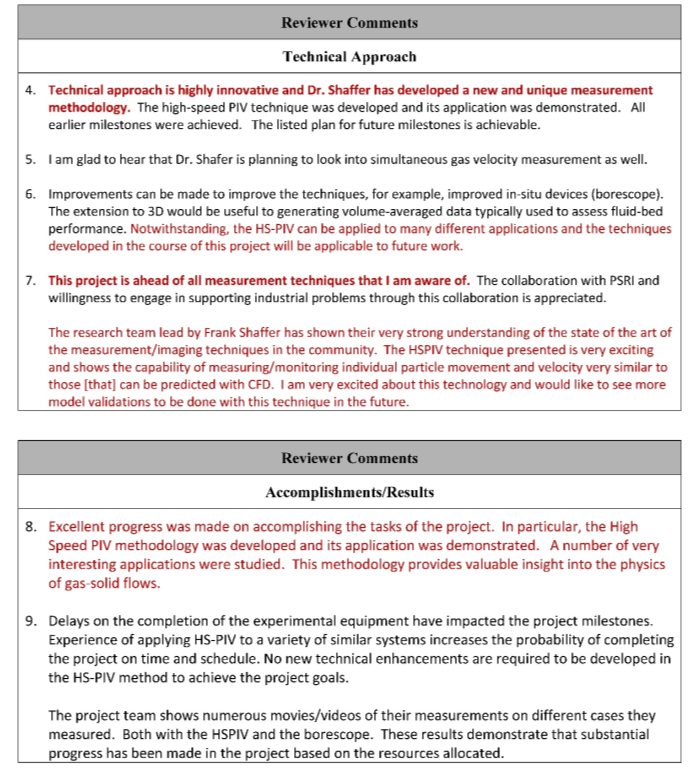
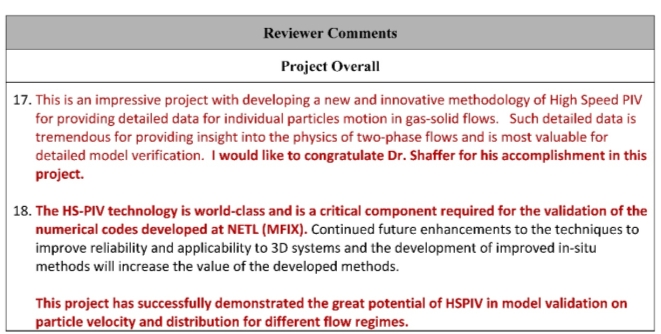
“A new high speed camera PIV methodology was developed and was demonstrated. Such detailed data are most valuable for detailed model verification.” “This tool will be invaluable in better quantifying the results of CFD models.” “This project is ahead of all measurement techniques that I am aware of.” “The research team led by Frank Shaffer has shown their very strong understanding of the state-of-the-art of measurement/imaging techniques in the community.”
“The HSPIV technique presented is very exciting and shows the capability of measuring/monitoring individual particle movement and velocity
“I am very excited about this technology and would like to see
“Excellent progress was made on accomplishing the tasks of the project.”
“The High Speed PIV methodology was developed
“A number of very interesting applications were studied.” “This methodology provides valuable insight into the physics of gas-solid flows.” |
|
UNSOLICITED COMMENTS FROM INDEPENDENT EXPERTS
|
||||||||||||||
|
|
“Itwasgreattoseeyourworkonclusteringandtodiscussthiswithyouinperson.…it(High Speed PIV data) is excellent data… I look forward to working with you guys more on this problem.”
Professor
Shankar
Subramaniam
|
|
I worked at the labs of Particulate Science Research Inc (PSRI) in Chicago about a month each year for several years. I worked closely with Dr. Ray Cocco, the President and CEO of PSRI. I applied the new High Speed Particle Imaging technology (what would become Patent 8,391,522) to industrially relevant fluidization units at PSRI’s labs. PSRI is a research consortium with 30 member companies headquartered in Canada, France, Brazil, Finland, Germany, India, South Africa, Saudi Arabia and the United States. We were able to see, for the first time, the formation of particle clusters under industrially relevant conditions. I was able to measure the size, trajectories, velocities and concentration of clusters. Below are some of the comments by Dr. Cocco about my work in a letter to Dr. Bill Rogers, Director of the NETL Multiphase Flow Science Program. A copy of the entire letter is in the Appendix. |

|
Dr. Ray Cocco |
“PSRI and Frank Shaffer of NETL have been leveraging resources to get better data on the complex hydrodynamics in risers and fluidized beds in our industry research units. So far, with the assistance of your high-speed particle imaging technology, we have already captured images of particle clusters above and in a fluidized bed for the first time. Before this work, there was no direct evidence that clusters existed in fluidized beds. Only circumstantial evidence has been available. As you know, particle clustering can significantly alter the performance of industrial processes.” |
|
“In addition, we have been able to acquire two-dimensional particle velocity and concentration maps inside our 8” CFB riser for the first time. We now have images and subsequent data in our 8 inch x 72 foot CFB riser for FCC powder in dense conditions and high velocities similar to those found in industrial FCC risers. Thus, we would like to invite Frank back to PSRI on several visits…. I believe this partnership will provide some of the key data needed for developing better models for particles having a commercially relevant particle size distributions” |
|
|
APPENDICES |
|
FULL MERIT REVIEW 2009
FULL MERIT REVIEW 2011
ABOUT MY FEDERAL SERVICE FOR MY COUNTRY (Return to Homepage)
|
*