

ABOUT MY FEDERAL SERVICE FOR MY COUNTRY (return to homepage)

MY COOPERATIVE RESEARCH & DEVELOPMENT AGREEMENTS
BETWEEN THE USDOE AND OUTSIDE ORGANIZATIONS
|
WWII US Navy Pilot, President George H.W. Bush |
Cooperative Research and Development Agreements were the brainchild of a love affair between President George H.W. Bush and The Prime Minister of England, Baroness Margaret Thatcher. The stimulate economic growth, the US Department of Energy and England’s Harwell Atomic Energy Agency began to spin-off technologies to the private sector through CRADAs. |
Baroness Margaret Thatcher. Prime Minister of England |
|
|
Thatcher earned the nickname "The Iron Lady" from a Soviet journalist in for her hardline anti-communist rhetoric. |
|||
|
THE FIRST COOPERATIVE RESEARCH AND DEVELOPMENT AGREEMENT BETWEEN THE US DEPARTMENT OF ENERGY
According to Kay Downey, the Technology Transfer Officer for the USDOE Pittsburgh Energy Technology Center, my CRADA with the University of Pittsburgh Schools of Medicine and Engineering was the first CRADA between the USDOE and an outside organization. |
|||
|
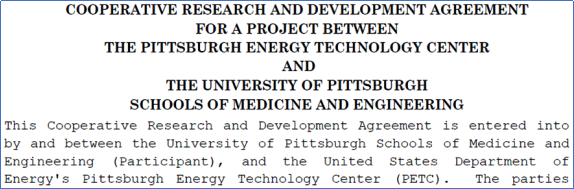
Below is the header for the CRADA. Click here or on the CRADA header below to see the entire CRADA |
|||
|
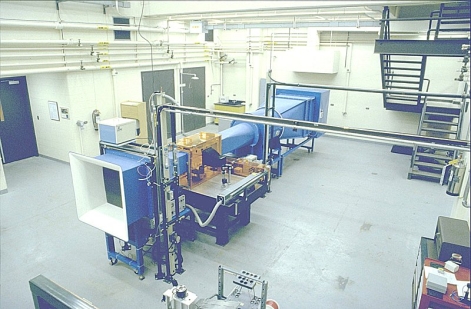
This is where the CRADA work was conducted, in my lab at the Pittsburgh site of the USDOE National Energy Technology Laboratory: |
|
In 1991, an artificial heart, the Novacor Left Ventricular Assist Device (LVAD), was in clinical trials in patients at the Presbyterian Hospital in Pittsburgh, St. Louis University Hospital, and Stanford Medical Center. For unknown reasons, the Novacor LVAD was causing micro-clots to be formed then released into the blood stream. This was causing strokes and fatalities in patients. Dr. Harvey Borovetz, then Assistant Director of the Artificial Heart Program at Presbyterian Hospital, visited my DOE Particle Flow Research Lab to ask for help in identifying what was causing “thrombogenesis” the formation of clots. We got to work immediately. The Novacor LVAD is implanted beside a failing human heart to take over the work of a failing heart until a heart is found for transplant. The bioengineers from the University of Pittsburgh used a Jarvik artificial heart to simulate the conditions of a failing human heart. |
|
|
Anatomical configuration of the Novacor Left Ventricular Assist Device (LVAD) |
A photo of the Novacor LVAD connected to a Jarvik artificial heart in my lab at the USDOE National Energy Technology Laboratory |
|
Heart Transplant Surgeon Dr. Bob Kormos prepares a Novacor LVAD for implant.
|
|
|
The research team for the CRADA with the
One of the technologies I used for my CRADA work was my US Patent 5,333,044 “Fluorescent Image Tracking Velocimetry” ), an imaging technology to visualize and measure the flow of organic and inorganic particles through power plants and the flow of blood cells in artificial hearts and lungs. The invention was made possible by my access to nuclear weapons technologies from the US’s and UK’s premier nuclear weapons labs. |
|
Click here to see a presentation by
Distinguished Professor of Bioengineering Dr. Harvey S. Borovetz

MY COOPERATIVE RESEARCH AND DEVELOPMENT
AGREEMENT WITH CARNEGIE MELLON UNIVERSITY
|
The Principal Investigator for CMU Professor of Chemical Engineering Dr. Jennifer Sinclair. She is now Distinguished Professor of Chemical Engineering at the University of California at Irvine. In 2023, she was awarded the American Institute of Chemical Engineering (AIChE) Margaret Hutchinson Rousseau Pioneer Award for Lifetime Achievement by a Woman Chemical Engineer. |
|
|
In 2019, Professor Sinclair was awarded the AIChE Particle Technology Lifetime Achievement Award. Particle technology was the subject of our CRADA. Click here or on the image below to see the Final Report for my CRADA with CMU: |
|

|
Dr. Jennifer Sinclair, Professor of Chemical Engineering at CMU. Now Distinguished Professor of Chemical Engineering at UC Irvine |
In memory of Dr. Gavin Sinclair. He passed away from cancer while Jennifer was pregnant with their daughter, Jeannine |
|
Seeing is believing. You can see the technology of my US Patent 8,391,552 at work in the video I made: The Science and Beauty of Fluidization . It is dedicated to one of the pioneers in Kinetic Theory of dense particle flows, Distinguished Professor Jennifer Sinclair, UC Irvine |
|
Click here or on the image below to watch Patent 8,391,552 in action

|
MY COOPERATIVE RESEARCH AND DEVELOPMENT AGREEMENT WITH ELECTROMEDIC The Principal Investigator for Electromedic was the great Dr. Gary Reeder, MD. Dr. Reeder was using the Electromedic Autotransfusion “cell saver” system to save blood from patients during heart and lung transplants at the University of Medical Center Presbyterian Hospital in Pittsburgh.
|
ABOUT MY FEDERAL SERVICE FOR MY COUNTRY (return to homepage)
FDShaffer@Gmail.com 412-320-0510


